

Fare: Inventive Swedish cuisine
Vibe: Friendly and Professional
Location: Malmö, Sweden

Vollmers is located in the centre of Malmö, Sweden. As soon as you walk in, you start an educational journey on Skåne, the southernmost county of Sweden, where the restaurant is located. The owners are a pair of brothers (Mats and Ebbe Vollmer) and the restaurant interior is full of notions of their great-grandparents’ history, from the cutlery to the nostalgic carpeted flooring.
Warmly welcomed by the host, we were led to our table in an immaculate dining room. The table spacing and layout of the room was very much fine dining, but the demanour of the staff brought a warm, familiar, and relaxed energy.
We were offered menus and the server confirmed that there would be no problem accommodating my partner who is a pescatarian. The server asked if we wanted to partake in the wine or non-alcoholic pairings. My partner took the wine and I took the non-alcoholic pairing, and throughout the meal, we definitely did not regret it.

It was interesting to see the distance from which main ingredients of each dish were sourced. This emphasised Vollmers’ focus on local ingredients and cuisine. The menu was already extensive, but little did we know there were many hidden surprises in store.
Time to Eat at Vollmers
The first dishes to come to our table were a series of snacks. This started with a spoonful of caviar aged 30 days in salt – very Swedish.

Then came a tartlet of raw shrimp from Smögen on the west coast of Sweden. It was dotted with ornate pearls of horseradish gel and dill. The tartlet had a simply crisp and clear taste.

Next was a Danish oyster with oyster cream and chive oil. Though a tiny bite, it was filled with multiple dimensions of oyster flavour.

Rounding off the snacks were two more small bites. The duck liver and elderberry tart had an lusciously smooth and sweet taste. The potato pancake had an interesting tangy flavour to it thanks to the topping of pork neck sprayed in pickle juice.


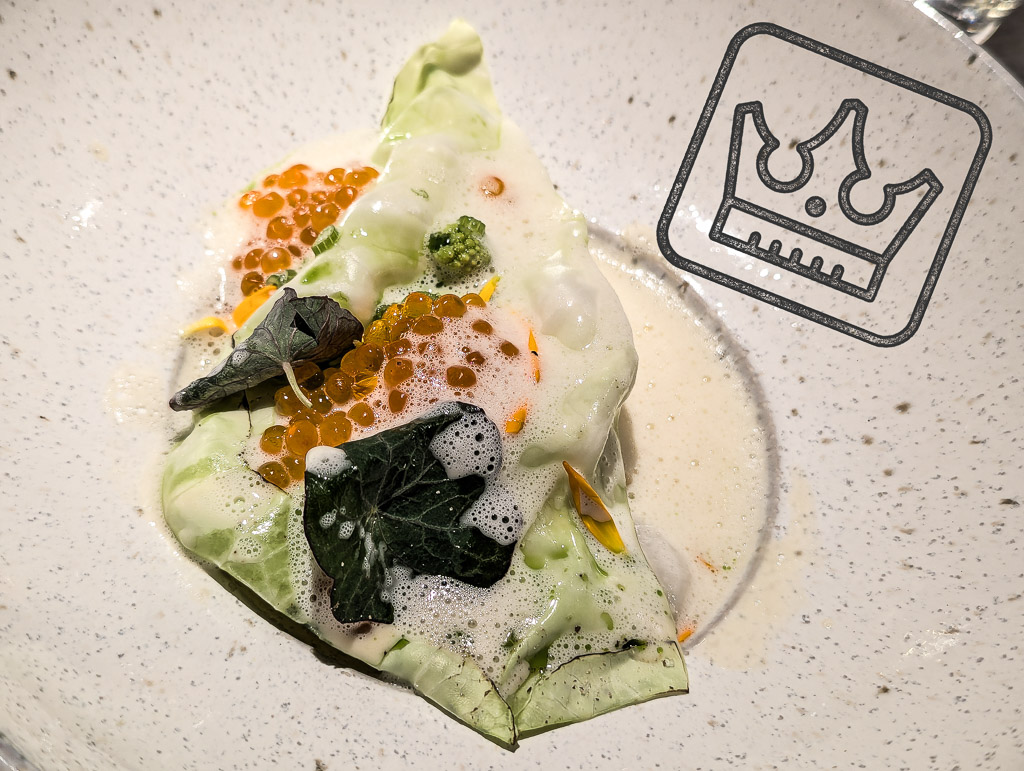
At this stage, we were quite dazzled by all the snacks. We were offered one last course served in two parts. They were an ode to a local humble onion: one vessel of onion served with savoy cabbage and tarragon foam, and one vessel with a pungent onion broth and Danish goat cheese. Of course the onion flavour came through in both components, but the dish in general was more subdued. When thinking of the meal as a whole, it worked as a nice interlude and preparation of the palete for the main part of the meal.


Onto the items on the printed menu: first up was “100 Year Old Bread”. Apparently this bread course was created to celebrate 100 years of sourdough culture in the area. The unique oblong shape of the bread meant a great crust to soft inside ratio. There were three breads: wheat, malt, and porcini brioche. All of them tasted great served with the two butters: cow’s milk butter with crème fraîche, and cow’s and goat’s milk butter. Throughout the meal, the bread board was continuously refilled. I appreciated this since I couldn’t get enough of them!

“Back to the Future” was a dish utilising ingredients from the first dish Vollmers ever served, 12 years ago. Cucumber was served three ways: compressed, torched, and in oil form. These dimensions were enhanced by raw cod, lemon, dill, and a mussel soup. I thought this was a well-composed dish, with every element contributing constructively to the overall flavour.
My non-alcoholic drink pairing for this was a mint drink which helped to cut through the saltiness of the dish.


One of my favourite dishes was next – “New Times”. This was a spin on a very classic Swedish dish, kålpudding (cabbage pudding). but with a lot of (good) bells and whistles. The cabbage was accompanied by salted pork, egg yolk gel, silver onions, a cabbage crisp, lingonberries, lingonberry powder, and capers. While the elements created a complex tasting dish, the essence of the traditional cabbage pudding still shone through. This dish was a great combination of old and new.

Next was “Umami”, which I found to be an adventure in technique and textures. The langoustine in this dish was fried on both sides, torched, and then smoked. As I bit in, I could taste and feel every preparation step. A beurre blanc made with langoustine broth added some creaminess. The langoustine was also accompanied by kohlrabi, apple, and walnut, which I found to be quite a novel flavour combination.

“In to the Forest” was the dish on the menu containing the most ultra-local ingredients, boasting a sourcing radius of only 8 km. Inside a beautiful weave of celeriac were oyster and brown mushrooms prepared with meadowsweet flowers. This all say on top of a luscious chicken and mushroom broth. On the side was also a snack of mushroom crisp and tree moss.
The non-alcoholic drink pairing for this course was an oxidised pear drink, which brought out the mushroom’s umami notes. In terms of menu progression, this dish was a smart and welcome interlude between the seafood dishes and the heavier proteins to come.


Diving into the proteins, “When The Cat Is Away” was a fried sweetbread fried in tree sap, and pickled radish. This is the sort of innovative and unusual dish that reminds me I’m dining at a high-calibre two Michelin Star restaurant. The non-alcoholic drink pairing was again expertly curated – this time a redcurrant juice with tartness to cut through the creamy sweetness of the dish.

At the peak of the meal was the dish “Earthbound”. Perfectly medium rare sirloin was doused in a bone marrow and beef stock sauce. On the side was a piece of beetroot with black truffle and topped with a beetroot meringue. This brought a lot of brightness to the dish. The non-alcoholic drink pairing was a raspberry juice that further brought out the fruity notes of the dish.

Onto the tail end of the meal, there was a pre-dessert in the form of a Danish cheese with rosehip water and gel, and bee pollen. It was interesting that there were sour notes peppered amongst the primarily flowery dish. I have to say I do prefer the European custom of having a cheese course before a sweet dessert, as opposed to the UK’s tendency to do it the other way around.

Dessert was presented as a three-part affair, all featuring Jerusalem artichokes (also known as sunchokes) and pears. The first dessert was a Jerusalem artichoke poached in Jerusalem artichoke water, Jerusalem artichoke oil, sorels, and pear ice cream. Even though there was a lot of the root vegetable, the dish ate very light and refreshing.

In a fun play, the second part of the dessert was the reverse of the first part: Jerusalem artichoke ice cream sat on top of minced pear, with an egg white cream and caramel. This was a nice and whimsical progression.

Finally, the server informed us that at Vollmers, it is tradition for them to serve a danish at the end of the meal incorporating the ingredients of the desserts. We were given a danish with pear, chantilly cream with Jerusalem artichoke water, and cardamom. It was a little bite of heaven.

The non-alcoholic drink pairing for the dessert course was a blueberry and black tea, which contrasted well with the pear and Jerusalem artichoke flavours.
Final Thoughts
What an adventure it is to dine at Vollmers! At every turn there was a novel flavour combination and/or technique. My Swedish partner said the menu really captured the essence of Swedish cuisine that he grew up with, while giving it fun and modern twists.
The dining room and concept was a unique experience, and the server was very friendly and personable. The manner of service combined professionalism with familiarity. As a non-drinker, I appreciated that there was a full non-alcoholic drink paring with drinks for every course that were very thoughtful and appropriate.
I’m definitely planning on visiting Vollmers again. Situated in the centre of Malmö, Vollmers is just a small jaunt from Copenhagen, and definitely worth a trip if you’re visiting the Danish capital.

Leave a Reply